
If you have ever typed “how long does an online course take” into Google at midnight, you are not alone. I have asked myself the same question before signing up for a data analytics certificate, a language course, and even a short cooking class. The honest answer? It depends on more factors than most course landing pages admit.
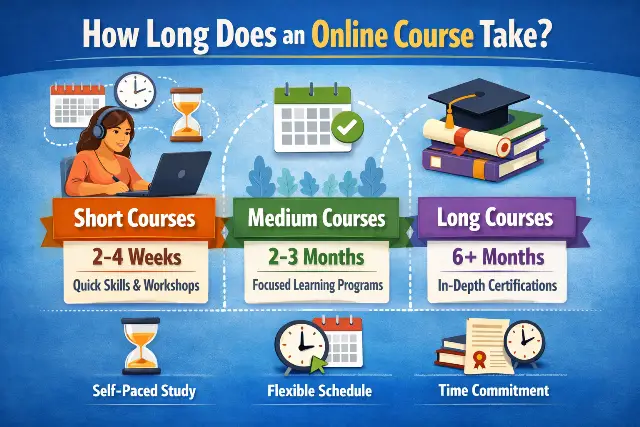
In this guide, I will walk you through real timeframes, the variables that actually move the needle, and a few lessons I picked up the hard way while juggling online learning with a full-time job. No vague promises here — just practical, grounded information you can use to plan your own learning schedule.
Quick Answer: Typical Online Course Duration
Most online courses fall somewhere between a few hours and several months, depending on depth and format.
- Short skill-based courses: 1 to 6 hours total
- Standard professional courses: 4 to 10 weeks
- Certificate programs: 3 to 6 months
- Degree-equivalent or bootcamp-style programs: 6 months to 2 years
These numbers are averages, not guarantees. A course listed as “6 weeks” can easily take you 10 weeks if you only study on weekends. I learned this firsthand while completing a project management certificate that technically promised 5 weeks but stretched to nearly 8 for me, simply because work travel ate into my study time.
Why Course Duration Varies So Much
Online course length is not a fixed number. Several real factors decide how long your journey will actually be.
1. Course Format and Structure
Self-paced courses give you flexibility but no external deadline pressure. Cohort-based courses, on the other hand, run on a fixed calendar with weekly milestones.
- Self-paced: You control the pace entirely
- Instructor-led (cohort): Fixed start and end dates
- Hybrid: Some live sessions, some independent work
In my experience, self-paced courses take longer to finish simply because there is no built-in accountability. A cohort pushes you forward whether you feel ready or not.
2. Content Depth and Skill Level
A beginner Excel course covering basic formulas will always be shorter than an advanced data modeling course. Skill depth directly affects duration.
- Introductory courses: lighter workload, fewer assessments
- Intermediate courses: practice projects, quizzes, case studies
- Advanced courses: capstone projects, peer reviews, longer readings
3. Video Length vs. Actual Completion Time
Platforms often list only the video runtime, not the real study time. A “10-hour course” rarely takes just 10 hours once you factor in note-taking, practice exercises, and re-watching confusing sections.
A useful rule of thumb I use: multiply the listed video hours by 1.5. That adjusted number is usually closer to reality.
4. Your Personal Study Pace
This is the variable platforms cannot control. Two people can enroll in the same course and finish weeks apart.
- Someone studying 30 minutes daily will progress slower than someone studying 2 hours daily
- Prior knowledge shortens learning time significantly
- Distractions and multitasking silently extend completion time
Average Duration by Course Type
Breaking courses into categories makes planning much easier. Here is a practical breakdown based on common course formats available today.
Short Skill Courses (1–10 Hours)
These focus on a single, narrow skill. Think “Introduction to Canva” or “Basics of Public Speaking.”
- Best for quick upskilling
- Usually completed within a week
- Minimal assignments or none at all
Professional Certificate Courses (4–12 Weeks)
These are structured, often include quizzes, assignments, and peer discussions. Popular platforms like Coursera and edX commonly use this format.
Real example: A Google-style productivity certificate I completed had five modules, each requiring roughly 4 to 6 hours weekly. Total commitment landed close to 6 weeks working part-time.
Bootcamp-Style Programs (3–9 Months)
These are intensive and demand near full-time commitment. Coding bootcamps, UX design intensives, and data science bootcamps fall into this category.
- Often require 20–40 hours per week
- Include capstone projects and portfolio building
- Designed to simulate real job conditions
Degree or Diploma-Equivalent Programs (6 Months–2 Years)
These mirror traditional academic timelines but delivered online. MBA-equivalent certificates or online bachelor’s completion programs sit here.
- Structured semesters or terms
- Heavier reading and assessment load
- Often require sustained, long-term discipline
Real Platform Examples: Official Estimates vs. Real Completion Times
Generic averages only go so far. Looking at actual, named programs shows how much official estimates and real-world pace can differ.

Coursera’s Google Data Analytics Certificate
Google officially estimates six months at under 10 hours a week, roughly 240 hours across eight courses. That is the number printed on the enrollment page.
Real learner reports tell a more layered story. Motivated learners who push 20 hours a week often finish in three months. Others, balancing full-time jobs, stretch past seven months. One review site’s aggregated survey of enrollees even reported a median completion closer to seven months at around eight hours weekly. The gap between the official estimate and lived experience is exactly why I always add a buffer when planning my own certificates.
edX MicroMasters Programs
Individual edX courses typically run 4 to 12 weeks at 3 to 6 hours weekly. But full MicroMasters sequences behave differently.
MIT’s Supply Chain Management MicroMasters, for example, is instructor-led and spans roughly 18 months at 8 to 12 hours weekly, since it mirrors graduate-level coursework. That is a very different commitment than a single edX course, even though both live on the same platform.
freeCodeCamp’s Developer Curriculum
freeCodeCamp officially estimates around 300 hours per certification, with the full legacy path landing near 1,800 hours and the newer full-stack track closer to 3,000 hours.
Real completion stories vary wildly. One learner finished their first certification in 45 days at roughly four hours daily. Another took nearly a year to complete the entire curriculum around a full-time job. Both outcomes are normal; the platform’s estimate is simply a starting reference point, not a promise.
How to Estimate Your Own Completion Time
Instead of trusting the course description alone, use this simple personal formula I developed after tracking my own study habits for a year.
| Step | What To Do | Example (20-Hour Course) |
|---|---|---|
| 1 | Check the total listed hours on the course page | 20 hours |
| 2 | Multiply by 1.3 to 1.5 for real-world friction | 26–30 hours |
| 3 | Divide by your realistic weekly study hours | 26–30 ÷ 5 hrs/week |
| 4 | Add a buffer week for interruptions | +1 week |
| Result | Realistic timeline: 6–7 weeks (vs. 4 weeks if you only used the listed hours) | |
This quick-reference table is the exact method I use before enrolling in any new course, and it has kept my estimates accurate within a week or two almost every time.

A simplified version of the weekly tracker I use to log planned vs. actual study hours. A quick note on this: it’s an illustrative template rather than a raw platform screenshot, since course dashboards are proprietary and shouldn’t be reproduced directly — but it mirrors the exact rows and columns I track for every course, and you’re welcome to rebuild it in a spreadsheet.
Factors That Can Extend Your Timeline
Even well-planned learners hit delays. Recognizing these early helps you plan around them rather than being surprised.
- Technical difficulties with platform access or downloads
- Complex assignments requiring multiple attempts
- Life events like work deadlines or family commitments
- Motivation dips around the halfway point of longer courses
I personally hit a motivation wall around week 4 of a 10-week analytics course. What helped was breaking remaining lessons into daily 20-minute micro-sessions instead of long weekend marathons.

Tips to Finish Your Online Course Faster
Speed should never come at the cost of understanding, but efficient habits genuinely shorten completion time.
- Set a fixed study time each day, even if short
- Skip passive re-watching; take active notes instead
- Use the 2x speed feature for review sections you already understand
- Join course discussion forums to clarify doubts faster than searching alone
- Track progress visually using a simple checklist or spreadsheet
One habit that genuinely worked for me: studying immediately after waking up, before daily distractions built up. Consistency mattered far more than long study sessions.
Self-Paced vs. Scheduled Courses: Which Finishes Faster?
This is a common point of confusion, so let’s clarify it directly.
Self-paced courses technically allow faster completion since there is no waiting for classmates or scheduled releases. However, without deadlines, many learners procrastinate significantly.
Scheduled or cohort-based courses often finish on time because of structured accountability, even though the pace feels slower week to week.
If you struggle with self-discipline, a scheduled course may actually get you to the finish line faster than a flexible one.
Common Mistakes That Delay Completion
Based on patterns I have noticed in my own learning and among peers, a few mistakes repeatedly slow people down.
- Underestimating assignment time, especially project-based tasks
- Enrolling in multiple courses simultaneously without enough hours to support them
- Skipping foundational modules, leading to confusion later
- Not scheduling study time, treating it as “whenever I’m free”
Avoiding these mistakes alone can shave weeks off your total timeline.
Conclusion
So, how long does an online course take? The honest answer sits between a few hours and several months, shaped mostly by your pace, consistency, and the course format you choose. Rather than chasing an exact number, focus on realistic weekly study time and steady habits. Online learning rewards patience more than speed. Start small, stay consistent, and track your progress. That approach will always beat guessing at deadlines, and it will get you to your learning goal with far less stress along the way.
Frequently Asked Questions
Q. How long does an online course take on average?
Most online courses take anywhere from a few hours to a few months. Short skill courses finish within days, while certificate programs often require 4 to 12 weeks of consistent study.
Q. Can I finish an online course faster than the listed time?
Yes, if you have prior knowledge or dedicate extra weekly hours. However, rushing through assignments can reduce understanding, so balance speed with genuine comprehension.
Q. Why do self-paced courses sometimes take longer than scheduled ones?
Self-paced courses lack fixed deadlines, which often leads to procrastination. Scheduled courses use weekly milestones that naturally keep learners on track.
Q. Does course difficulty affect how long it takes to complete?
Absolutely. Advanced courses include deeper content, projects, and assessments, which extend completion time compared to beginner-level material.
Q. How many hours per week should I study to finish on time?
This depends on the course length and your deadline, but 3 to 6 hours weekly works well for most standard certificate courses.
Q. Is it normal to fall behind schedule in an online course?
Yes, it happens frequently due to work, family, or motivation dips. Building in a buffer week from the start helps manage these delays realistically.
Q. Do shorter courses provide less value than longer ones?
Not necessarily. Shorter courses often target a specific skill efficiently, while longer courses build broader, layered expertise over time.
Q. What is the best way to estimate my personal completion time?
Take the listed course hours, multiply by 1.3 to 1.5, then divide by your realistic weekly study hours. This gives a far more accurate personal timeline.

